Thursday, September 22, 2016

AWS Enterprise Support Update – Training Credits, Operations Review, Well-Architected

I often speak to new and potential AWS customers in our EBC (Executive Briefing Center) in Seattle. The vast majority of them have already bought in to the promise of the cloud and are already making plans that involve a combination of  “lifting and shifting” existing applications and building new, cloud-native ones. Because their move to AWS is often part of a larger organizational transformation and modernization, the senior leaders that I talk to want to make sure that their technical team is properly equipped to skillfully design, build, and operate cloud-powered systems.


Many of these customers are taking advantage of the AWS Enterprise Support plan as they move their mission-critical applications to the cloud. Like traditional support plans, this one provides access to technical support people and resources in the event that an issue surfaces. However, unlike traditional plans, it also focuses on helping them to build applications that are robust, cost-effective, easily maintained, and scalable. Our customers tell me that they enjoy the unique combination of hands-on, concierge-quality support and the automated, data-driven recommendations provided to them by AWS Trusted Advisor.


New Enterprise Support Benefits
Today we are making the AWS Enterprise Support Plan even better, adding three new benefits that are available to new and existing plan subscribers at no additional charge:


Training Credits – In conjunction with our training partner qwikLabs, each Enterprise Support customer is entitled to receive 500 qwikLabs training credits annually, along with a 30% discount on additional credits. The qwikLabs courses address a wide range of AWS topics; introductory courses are free and the remainder cost between 1 and 15 credits each (read the course catalog to learn more):


If you have an Enterprise Support plan and would like to gain access to your credits and discounts, please contact your AWS Technical Account Manager (TAM).


Cloud Operations Review – Enterprise Support customers are eligible for a Cloud Operations Review designed to help them to identify gaps in their approach to operating in the cloud. Originating from a set of operational best practices distilled from our experience with a large set of representative customers, this program provides you with a review of your cloud operations and the associated management practices. The program uses a four-pillared approach with a focus on preparing, monitoring, operating, and optimizing cloud-based systems in pursuit of operational excellence.


You can work with your TAM to set up a Cloud Operations Review.


Well-Architected Review – Enterprise Support customers are also eligible for a Well-Architected Review of their mission-critical workloads. While the Cloud Operations Review focuses on people and processes, this review allows our customers to measure their architecture against AWS best practices. Our goal is to help our customers to construct architectures that are secure, reliable, performance, and cost-effective. For more information about our Well-Architected program, read Are You Well-Architected?

-
Jeff;


Wednesday, September 21, 2016

Here Comes the First Wearable Alexa-Enabled Device!

There's no doubt that you know who Alexa is.  We've talked about her a bunch of times on this blog already.  Alexa is indeed the most popular digital personal assistant in town!  It powers the Echo, Dot and Tap – Amazon's smart home devices that allow you to ask Alexa to do certain … Continue reading Here Comes the First Wearable Alexa-Enabled Device! →

Additional At-Rest and In-Transit Encryption Options for Amazon EMR

Our customers use Amazon EMR (including Apache Hadoop and the full range of tools that make up the Apache Spark ecosystem) to handle many types of mission-critical big data use cases. For example:


  • Yelp processes over a terabyte of log files and photos every day.

  • Expedia processes streams of clickstream, user interaction, and supply data.

  • FINRA analyzes billions of brokerage transaction records daily.

  • DataXu evaluates 30 trillion ad opportunities monthly.


Because customers like these (see our big data use cases for many others) are processing data that is mission-critical and often sensitive, they need to keep it safe and sound.


We already offer several data encryption options for EMR including server and client side encryption for Amazon S3 with EMRFS and Transparent Data Encryption for HDFS. While these solutions do a good job of protecting data at rest, they do not address data stored in temporary files or data that is in flight, moving between job steps. Each of these encryption options must be individually enabled and configured, making the process of implementing encryption more tedious that it need be.


It is time to change this!


New Encryption Support
Today we are launch a new, comprehensive encryption solution for EMR. You can now easily enable at-rest and in-transit encryption for Apache Spark, Apache Tez, and Hadoop MapReduce on EMR.


The at-rest encryption addresses the following types of storage:


  • Data stored in S3 via EMRFS.

  • Data stored in the local file system of each node.

  • Data stored on the cluster using HDFS.


The in-transit encryption makes use of the open-source encryption features native to the following frameworks:


  • Apache Spark

  • Apache Tez

  • Apache Hadoop MapReduce


This new feature can be configured using an Amazon EMR security configuration.  You can create a configuration from the EMR Console, the EMR CLI, or via the EMR API.


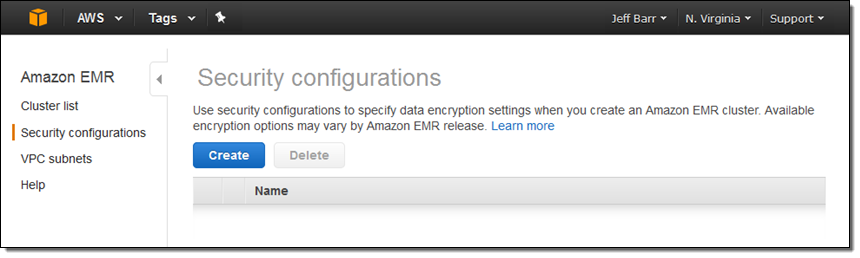
The EMR Console now includes a list of security configurations:


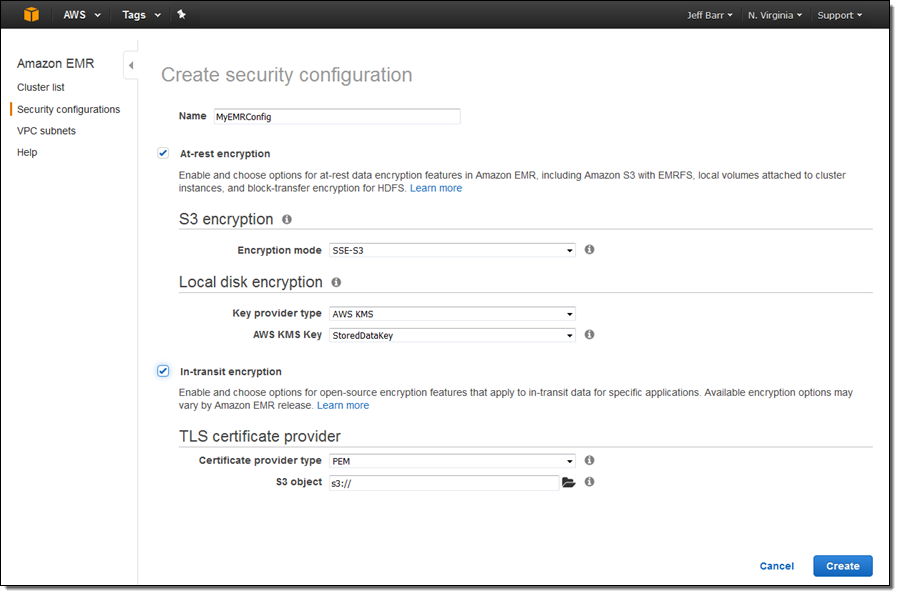
Click on Create to make a new one:


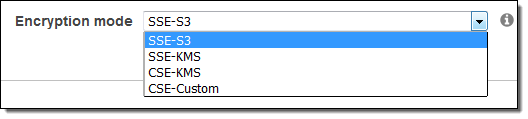
Enter a name, and then choose the desired mode and type for each aspect of this new feature. Based on the mode or the type, the console will prompt you for additional information.


S3 Encryption:


Local disk encryption:


In-transit encryption:


If you choose PEM as the certificate provider type, you will need to enter the S3 location of a ZIP file that contains the PEM file(s) that you want to use for encryption. If you choose Custom, you will need to enter the S3 location of a JAR file and the class name of the custom certificate provider.


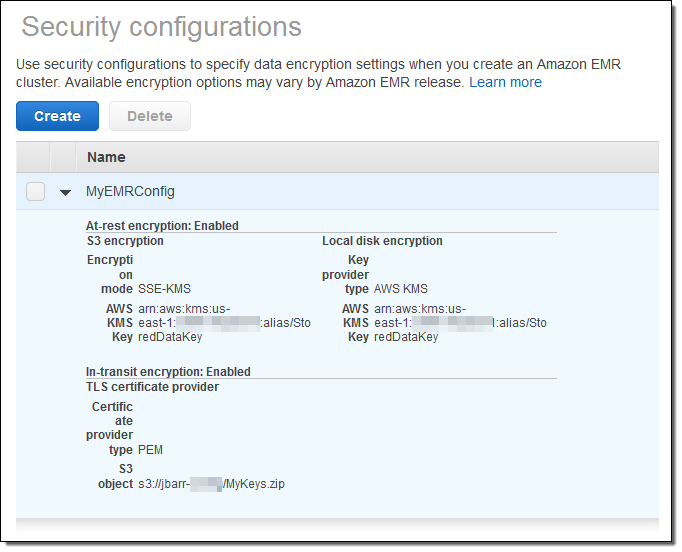
After you make all of your choices and click on Create, your security configuration will appear in the console:


You can then specify the configuration when you create a new EMR Cluster. This feature is available for clusters that are running Amazon EMR release 4.8.0 or 5.0.0. To learn more, read about Amazon EMR Encryption with Security Configurations.

-
Jeff;


Tuesday, September 20, 2016

API Gateway Update – New Features Simplify API Development

Amazon API Gateway allows you to quickly and easily build and run application backends that are robust and scalable. With the recent addition of usage plans, you can create an ecosystem of partner developers around your APIs. Let's review some terminology to start things off:


Endpoint – A URL (provided by API Gateway) that responds to HTTP requests. These requests use HTTP methods such as GET, PUT, and POST.

Resource – A named entity that exists (symbolically) within an endpoint, referred to by a hierarchical path.


Behavior – The action that your code will take in response to an HTTP request on a particular resource, using an HTTP method.


Integration – The API Gateway mapping from the endpoint, resource, and HTTP method to the actual behavior, and back again.


Today we are extending the integration model provided by API Gateway with support for some new features that will make it even easier for you to build new API endpoints and to port existing applications:


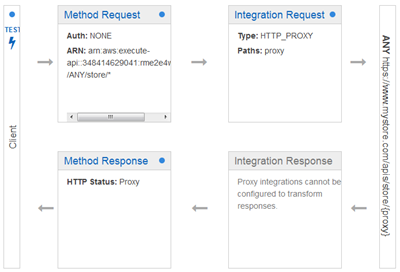
Greedy Path Variables – Instead of specifying individual paths and behaviors for groups of requests that fall within a common path (such as /store/), you can now specify a “greedy” route that intercepts all requests to the path and routes them to the same function. For example a single greedy path (/store/{proxy+}) will intercept requests made to /store/list-products, /store/add-product, and /store/delete-product.


ANY Method – Instead of specifying individual behaviors for each HTTP method (GET, POST, PUT, and so forth) you can now use the catch-all ANY method to define the same integration behavior for all requests.


Lambda Function Integration – A new default mapping template will send the entire request to your Lambda function and then turn the return value into an HTTP response.


HTTP Endpoint Integration – Another new default mapping template will pass the entire request through to your HTTP endpoint and then return the response without modification. This allows you to use API Gateway as an HTTP proxy with very little in the way of setup work.


Let's dive in!


Greedy Path Variables
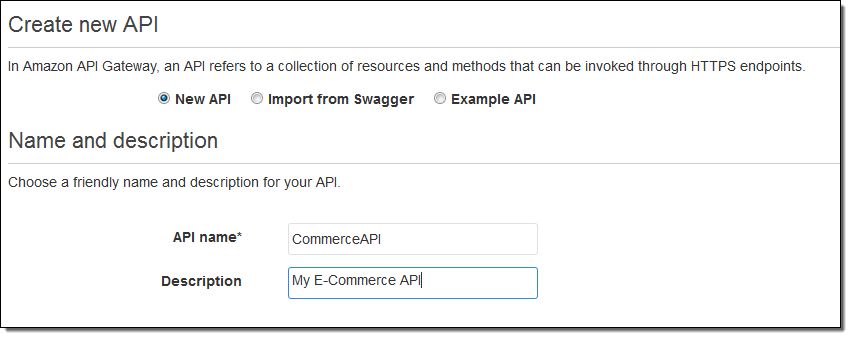
Suppose I am creating a new e-commerce API. I start like this:


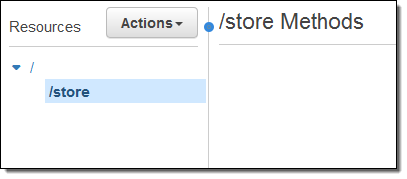
And then create the /store resource:


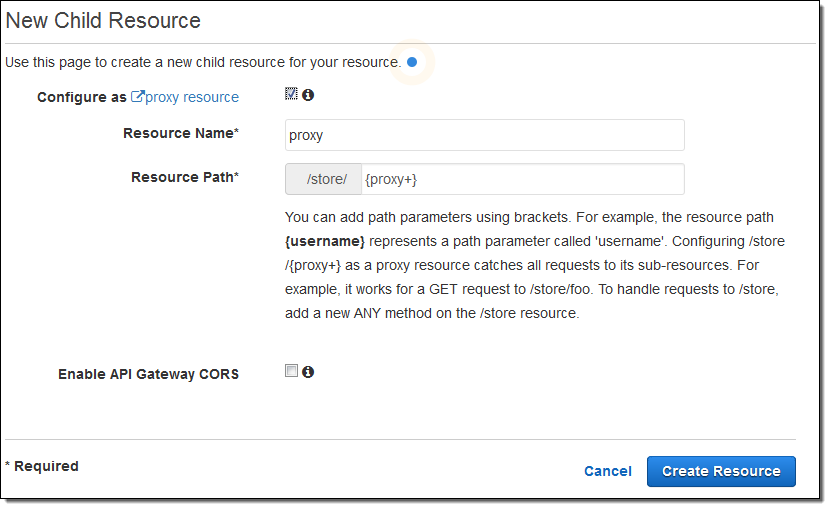
Then I use a greedy path variable to intercept all requests to any resource within /store (I also had to check Configure as proxy resource):


Because {proxy+} routes requests for sub-resources to the actual resource, it must be used as the final element of the resource path; it does not make sense to use it elsewhere. The {proxy+} can match a path of any depth; the example above would also match /store/us/clothing, /store/us/clothing/children, and so forth.


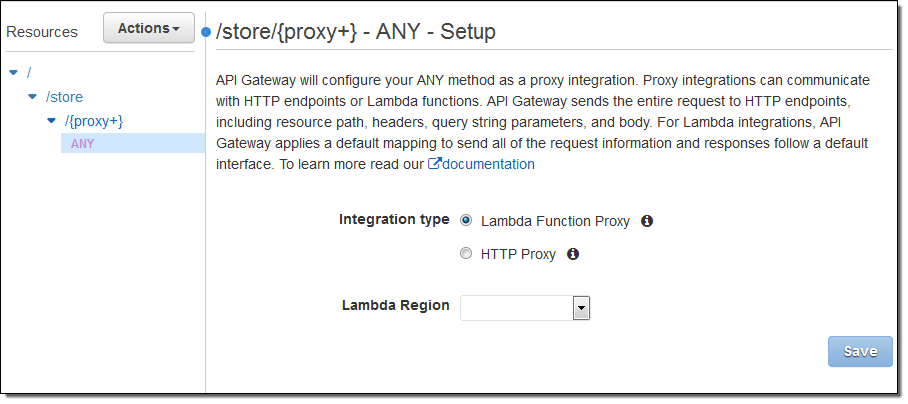
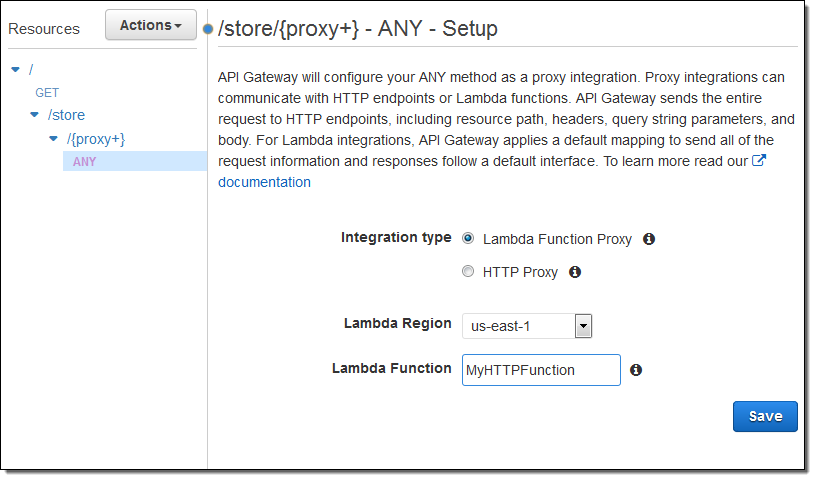
The proxy can connect to a Lambda function or an HTTP endpoint:


ANY Method
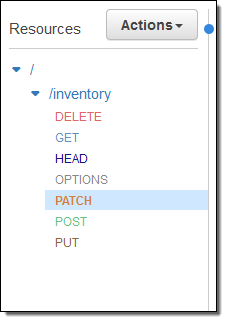
I no longer need to specify individual behaviors for each HTTP method when I define my resources and the methods on them:


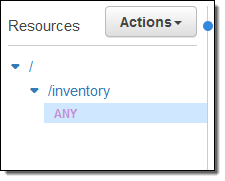
Instead, I can select ANY and use the same integration behavior for all of the methods on the resource:


This is cleaner, simpler, and easier to set up. Your code (the integration point for all of the methods on the resource) can inspect the method name and take an appropriate action.


The ANY method is created automatically when I use a greedy path variable, as shown above. It can also be used for individual resources. You can override the configuration for an individual method (perhaps you want to handle DELETE differently), by simply creating it and changing the settings.


Lambda Function Integration
It is now easier than ever to implement a behavior using a Lambda function. A new, built-in Lambda integration template automatically maps the HTTP request elements (headers, query parameters, and payload) into a form directly consumable by the function. The template also maps the function's return value (an object with status code, header, and body elements) to a properly structured HTTP response.


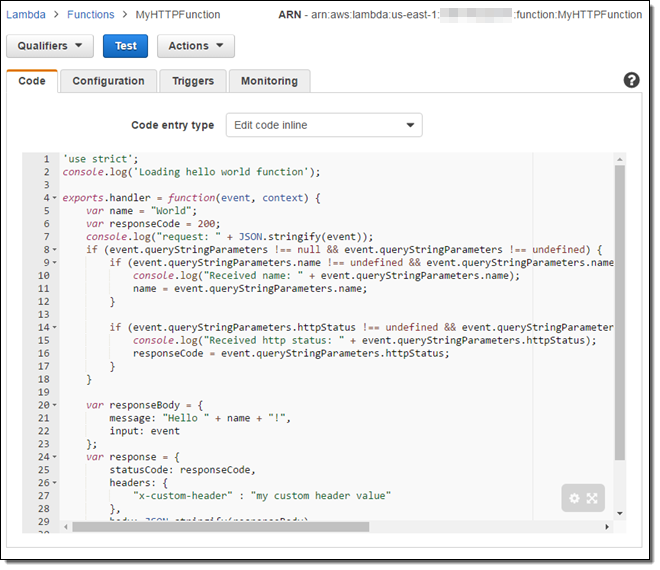
Here's a simple function that I copied from the documentation (you can find it in [Lambda Function for Proxy Integration]):


I connected it to /store like this:


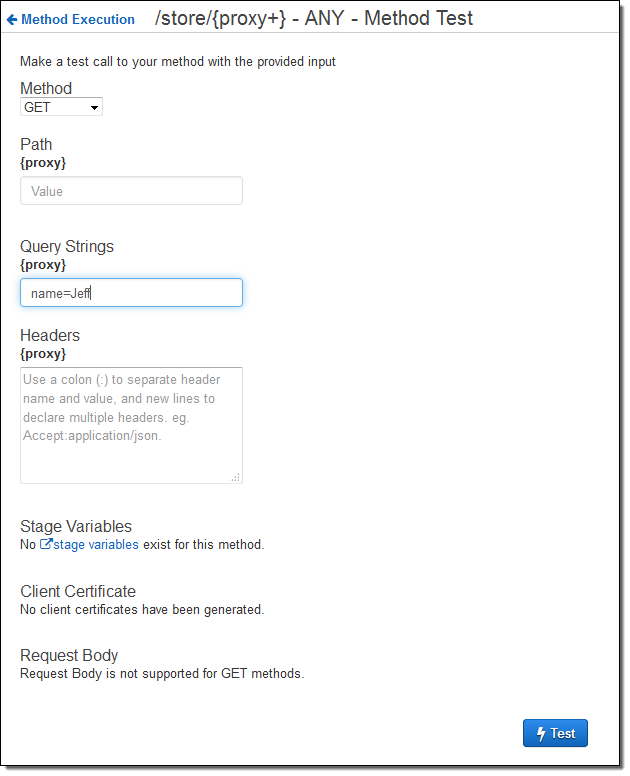
Then I deployed it (not shown), and tested it out like this:


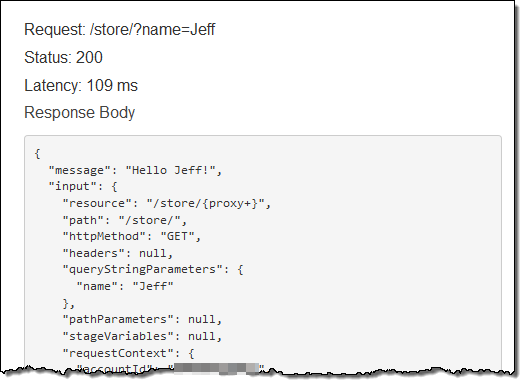
The function ran as expected; the console displayed the response body, the headers, and the log files for me. Here's the first part:


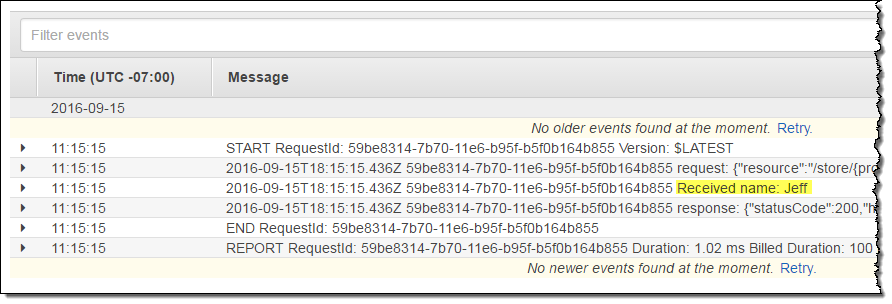
Then I hopped over to the Lambda Console and inspected the CloudWatch Logs for my function:


As you can see, line 10 of my function produced the message that I highlighted in yellow.


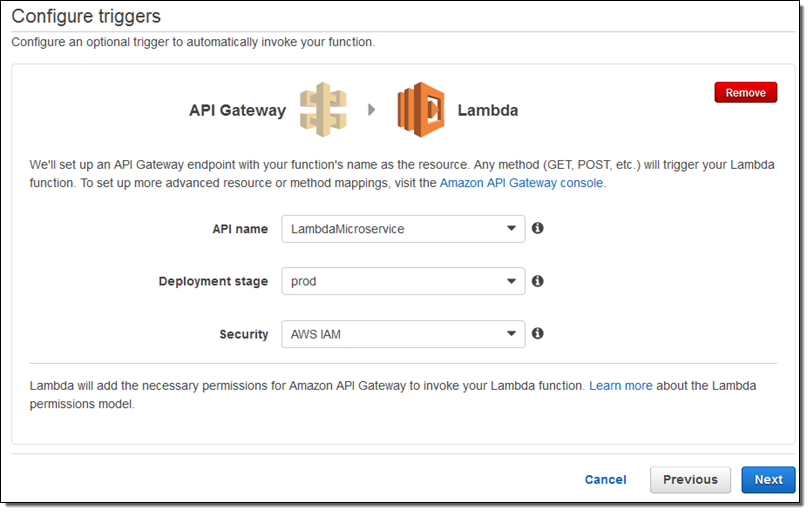
So, to sum it all up: you can now write Lambda functions that respond to HTTP requests on your API's resources  without having to spend any time setting up mappings or transformations. In fact, a new addition to the Lambda Console makes this process even easier! You can now configure the API Gateway endpoint as one of the first steps in creating a new Lambda function:


HTTP Function Integration
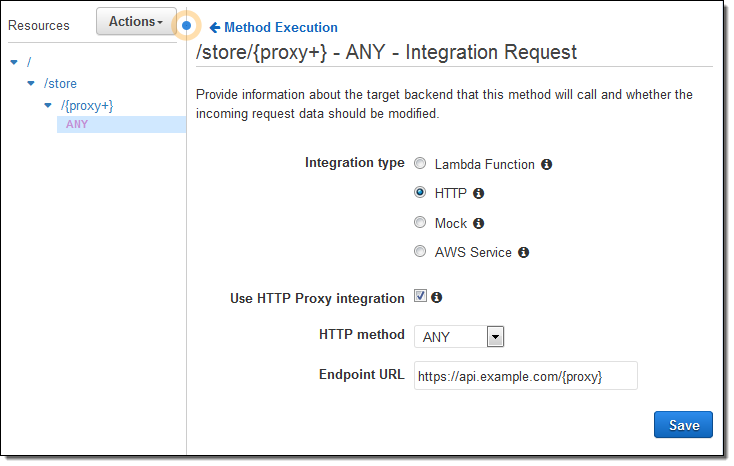
You can also pass API requests through to an HTTP endpoint running on an EC2 instance or on-premises. Again, you don't have to spend any time setting up mappings or transformations. Instead, you simply select HTTP for the integration type, click on Use HTTP Proxy integration, and enter the name of your endpoint:


If you specify an HTTP  method of ANY, the method of the incoming request will be passed to the endpoint as-is. Otherwise, the method will be set to the indicated value as part of the call.


Available Now
The features described above are available now and you can start using them today at no extra charge.

-
Jeff;


The Latest Smart Gears on Amazon Launchpad

The Amazon Launchpad is the perfect place to discover unique and unexpected products from today's brightest startups.  It features different categories from food products to gadgets.  You can also find different collections crowdfunded by Indigogo, Portfolia, Kickstarter and CircleUp. But in this article, let's focus on the hottest and latest smart gears available … Continue reading The Latest Smart Gears on Amazon Launchpad →

Monday, September 19, 2016

Better Late Than Never, Nikon Joins the Action Cam Market!

They are small, tough and the perfect accessory for every adventure – action cameras have definitely earned a spot in every photo junkie's arsenal; traveler or not. There are a lot of brands who already released their own action cams but we all know that GoPro is the market leader with its iconic … Continue reading Better Late Than Never, Nikon Joins the Action Cam Market! →

AWS Week in Review – September 12, 2016

Wow! Twenty five (25) external and internal contributors worked together to create this edition of the AWS Week in Review. If you would like to join the party (with the possibility of a free lunch at re:Invent), please visit the AWS Week in Review on GitHub.


Monday

September 12


Tuesday

September 13


Wednesday

September 14


Thursday

September 15


Friday

September 16


Saturday

September 17


Sunday

September 18


New & Notable Open Source


New SlideShare Presentations


New Customer Success Stories


  • City of Chicago used AWS for the flexibility and agility to launch OpenGrid, Chicago's highest profile technology release to date. OpenGrid is a real-time, open source situational awareness program intended to improve the quality of life for citizens and improve efficiency of city operations.

  • Dable develops Omni-channel Personalization Platforms that recommend products/contents customers might be interested in based on big data. The company uses AWS Lambda, Amazon Lambda, and Amazon Redshift to analyze data in real time so it can provide customers with recommended services in a short period of time and in the most cost-effective way.

  • Gett scales to keep up with 300 percent annual growth, saves $800,000 yearly, and gains new business insights using AWS. The company provides an online taxi reservation service used by millions of people in Europe, Israel, and the US. Gett runs its website and mobile web application on AWS, relying on Amazon EC2 Spot Instances to optimize costs.

  • Kyowa Hakko Kirin began using AWS with its production run for SAP ERP, an enterprise resource-planning software. Kyowa Hakko Kirin is a pharmaceutical company that manufactures and sells prescription drugs. As the company continues migrating nearly all its systems and data off of physical servers and into the cloud, it is making further progress and reducing costs through strategies such as using reserved instances and stopping unnecessary instances on weekends. The company is developing its cloud data center as a result.

  • National Bank of Canada's Global Equity Derivatives Group (GED) uses AWS to process and analyze hundreds of terabytes of financial data, conduct data manipulations in one minute instead of days, and scale and optimize its operations. GED provides stock-trading solutions and services to a range of organizations throughout the world. The organization runs its data analysis using the TickVault platform on the AWS Cloud.


New YouTube Videos


Upcoming Events


Help Wanted


Stay tuned for next week! In the meantime, follow me on Twitter and subscribe to the RSS feed.

-
Jeff;