Thursday, November 12, 2015

Effective Renewable Energy Policies Spur Investment and Economic Growth

Today we have a very special guest post. My colleague Shannon Kellogg is a senior member of our Public Policy team. He has an interesting perspective on the role of public policies for renewable energy, with a focus on how they affect investment and economic growth.

Jeff;


In late September, I traveled to Virginia’s Eastern Shore to join Governor Terry McAuliffe and other state and local officials for his announcement of the Commonwealth’s issuance of its first permit for a new 80 megawatt solar facility that will be constructed in Accomack County. Amazon Web Services (AWS) has partnered with Community Energy to build the new installation — Amazon Solar Farm US East — and the project is expected to more than quadruple the amount of solar energy currently installed in Virginia. In his announcement, Governor McAuliffe said: “The partnership between Community Energy and Amazon Web Services, which will result in the largest solar facility in the mid-Atlantic, is indicative of the types of opportunities that my Administration is working toward through our commitment to build a new Virginia economy.”

We are excited about the positive impact that Amazon Solar Farm US East can have on the local economy in Virginia as our company continues to push for more renewable energy sources nationwide. To date, we have made significant progress toward advancing renewable energy by teaming up with developers in Indiana and North Carolina to announce new wind farms in those states as well as the new solar installation on Virginia’s Eastern Shore. These projects will deliver power to electrical grids that supply current and future AWS Cloud Computing data centers. Together these three projects will generate enough new renewable energy to power the equivalent of 122,000 US homes, or a city about the size of Pittsburgh, Pennsylvania. We expect that the contracts we have with developers for these three installations will allow AWS to meet or exceed its goal of using 40 percent renewable power in our data centers globally by the end of 2016. That will be a major step forward in meeting our long-term goal of 100 percent renewable power for our global infrastructure.
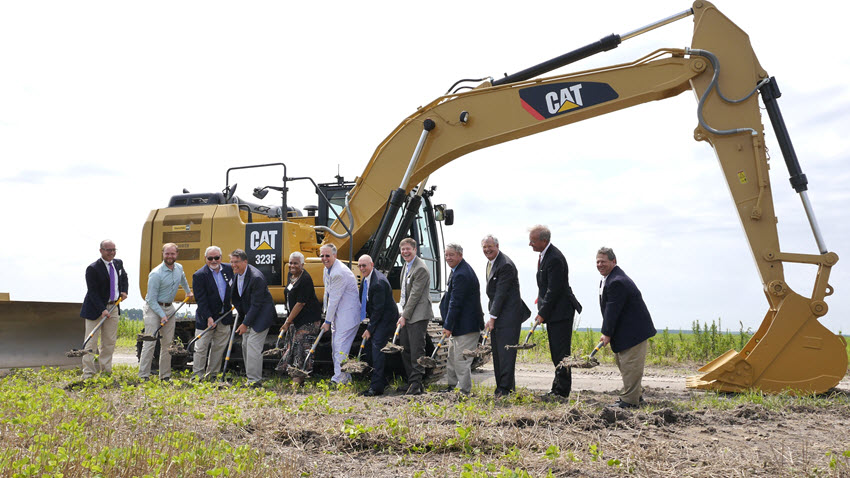
The ground-breaking ceremony for the Amazon Wind Farm US East in North Carolina, which included state and local government officials such as North Carolina Governor Pat McCrory.

When Amazon’s solar and wind farms turn on that much clean power, over time the power grid will have a reduced reliance on the equivalent amount of fossil fuel generation somewhere else because it’s no longer needed. We believe these investments help build the scale (and the business case) for solar and wind technology manufacturers to continue to innovate and continue to lower the costs of renewable power for everyone.

However, despite the progress that companies like Amazon are making toward the greater adoption of renewable energy sources, there is still quite a distance to go in the U.S. to make renewable energy sources widely available enough to keep up with growing demand by our industry and others. In August, The Economist stated that while in “some places wind turbines and solar cells are now a cheaper way of generating electricity than fossil fuels are,” the publication also noted that “renewables, other than hydropower, still provide less than 3 percent of the world’s energy.”

That gets to the second point The Economist editorial staff made; despite more solar and wind power sources being available that are priced competitively with fossil fuels, the percentage of the world’s energy in these categories is still very limited. It doesn’t have to be that way. By putting in place thoughtful policy – to provide certainty to businesses working in the renewable energy sector and to level the playing field with other sources of energy – our industry can accelerate and expand investments in new renewable projects, which will diversify the US electrical energy generation mix. That’s not only the right policy for businesses but it’s the right policy for our long-term energy security.

As federal energy and tax reform bills are considered by the U.S. Congress, policymakers have an opportunity to achieve an “all-of-the-above” energy policy that includes oil, gas, and renewable energy by giving investors access to a corporate structure with a tax advantage that is currently only available for fossil fuel-based energy projects. Congress should enact the Master Limited Partnerships (MLP) Parity Act, a bi-partisan bill introduced this summer that would give investors in renewable energy projects the same tax benefits that investors in the fossil fuel energy industry have been enjoying for decades.

There are also other steps that federal and state policymakers can take right now to ensure that renewable energy sources will continue to be competitively priced with fossil fuels in the near-term while wind and solar prices continue to fluctuate. First, Congress should adopt the two-year extension (through 2016) of the Production Tax Credit (PTC) for wind that was included in the tax extenders bill introduced in the Senate earlier this year; second, the Investment Tax Credit (ITC) for solar should be extended beyond 2016 if possible. At minimum, a proposed “commence construction” provision for the ITC should be included in any federal tax extender package enacted this year. This proposed change to the ITC would adjust the federal tax credit to allow projects to qualify for the ITC if construction on the project begins prior to the statutory expiration of the existing ITC on December 31, 2016, rather than the current requirement that the project is “placed in service” by ITC expiration.

In states such as Virginia that aim to create more renewable energy jobs it is time to pursue more competitive property tax rates for large-scale renewable projects, while also considering other policies to foster the construction of renewable energy projects such as a state-level investment tax credit that could eventually help replace the federal ITC. For those states that want to continue to attract renewable energy investment and the corresponding job creation, it is important to have the right policies in place for long-term impact to achieve the economic benefits that Governor McAuliffe, Governor McCrory, and other state leaders are seeking.

Together, advancement of these policies at both the federal and state levels could provide the runway and visibility to bring about a more abundant renewable energy future. Amazon will continue to work hard to invest in more renewable projects as AWS continues its march toward our 100 percent renewable power goal for its global infrastructure footprint. And, we are committed to working with our business partners, government policymakers and other stakeholders to help make it happen.

Shannon Kellogg, Director, AWS Public Policy

Tuesday, November 10, 2015

City on a Cloud Challenge Winners – 2015

The Challenge
Our City on a Cloud Innovation Challenge was designed to encourage local governments to use AWS to create innovative solutions to problems faced by local governments in the United States and other countries. Each year, we recognize winners in three categories: Best Practices, Dream Big, and Partners in Innovation.

Over the years that we have been operating this challenge, we have been impressed by the amount of energy and attention that local governments devote to creating tools, apps, and data sources that provide tangible benefits to their citizens, often assisting them with information that will allow them to lead lives that are safer more productive, and better informed.

And the Envelope Please!
I am pleased to be able to reveal the winners of the 2015 City on a Cloud Challenge!

There are three winners in the Best Practices category:

  • Louisville Metro Data Initiatives (Kentucky, US) – With a focus on open data and data-driven performance, the Louisville Metro Government created a series of custom sites hosted on AWS. The sites are designed to provide citizens with meaningful insights into government priorities and actions, along with the opportunity to review, analyze, and comment on government actions and processes.
  • King County (Washington, US) – This county has replaced a costly and expensive tape-powered backup and disaster recovery system with a modern, cloud-powered system that combines physical and virtual cloud-powered storage appliances with Amazon Glacier and S3, with a projected savings of $1 million in the first year, and $200K thereafter.
  • South Central Development and Planning Commission (Louisiana, US) -This county created MyGovernmentOnline. This site provides cloud-powered, location-oriented tracking of assets owned by government agencies of any size.

There are two winners in the Dream Big category:

  • City of Chicago (Illinois, US) – The city created OpenGrid, an open source information system that supports real-time monitoring and retrieval of historical data sources.
  • City of Marquette (Michigan, US) – The proposed CemeteryHost application will allow users to quickly and easy locate graves in Marquette’s historic Park Cemetery.

We would also like to recognize Trouver of Malaysia; their cross-platform collaborative tracking platform merits an honorable mention.

Finally, there are seven winners in the category of Partners in Innovation:

  • Seamless Docs (US) – A quick route to a paperless government, with conversion of existing forms and PDFs to online versions, including support for electronic signatures.
  • Quicket Solutions (US) – Cloud-based solutions for law enforcement to increase officer safety, boost patrol officer productivity, and increase public convenience.
  • Vizalytics Technology (US) -On-the-go insights for local businesses, residents, and government agencies, powered by real-time data sets from cities, states, and local governments.
  • GrupoTX (Colombia) – Improvements to government processes which lead to a better relationship between the citizens and the government.
  • DataCats (Canada) – An open source project that trivializes the creation of open data infrastructure for states, regional, and local governments.
  • ViewScan (Panama) – A web application that integrates GIS and transactional information to help citizens and government track urban changes, local businesses, transportation, public services, traffic, and environmental landmarks.
  • Park Smart (Italy) – A platform that provides real-time visibility into the availability of parking spaces in monitored areas.

Congratulations to all of the winners, and thanks again to everyone who took the time to create and submit an entry!

— Jeff;

Monday, November 9, 2015

AWS Webinars for November 2015 – Learn About New Services and Best Practices

As we did last month, we are running a series of webinars designed to bring you up to speed on the latest AWS services & features, and to make sure that you are aware of the best ways to put them to use.

The webinars are free but “seating” is limited and you should definitely sign up ahead of time if you want to attend (all times are Pacific):

Tuesday, November 17
AWS Device Farm allows you to test your mobile apps on real devices in an automated fashion.

Amazon QuickSight is a fast, cloud-powered business intelligence tool. You can build visualizations, perform ad-hoc analysis, and get business insights from your data.

CloudWatch Dashboards lets you to build customized metrics dashboards that display Amazon CloudWatch metrics from one or more AWS regions.

Wednesday, November 18
The Amazon ECS CLI gives you command-line access to Amazon EC2 Container Service. You can create clusters, list container instances, create and manage tasks, and more.

AWS Config Rules give you the ability to create compliance-checking rules that look for desirable or undesirable configurations of AWS resources.

Amazon S3’s Standard – Infrequent Access storage class is an economical way to store data that is rarely accessed.

Thursday, November 19
Over the past couple of years we have identified and refined a set of best practices for designing and building big data application that run on AWS.

Amazon Aurora is a fast and highly scalable relational database designed to be compatible with MySQL.

Amazon Redshift lets you build cost-effective data warehouses that can store well over a petabyte of data. Amazon Machine Learning helps you to perform predictive analytics on your data.

Jeff;

Friday, November 6, 2015

London Calling! An AWS Region is coming to the UK!

Yesterday, AWS evangelist Jeff Barr wrote that AWS will be opening a region in South Korea in early 2016 that will be our 5th region in Asia Pacific. Customers can choose between 11 regions around the world today and, in addition to Korea, we are adding regions in India, a second region in China, and Ohio in 2016.

Today, I am excited to add the United Kingdom to that list! The AWS UK region will be our third in the European Union (EU), and we're shooting to have it ready by the end of 2016 (or early 2017). This region will provide even lower latency and strong data sovereignty to local users.

More startups, small and medium businesses, large enterprises, universities, and government organizations all over the world are moving to the AWS Cloud faster than ever before. We are committed to meeting our customers’ increasing needs for capacity and for powerful AWS services that eliminate the heavy lifting of the underlying IT infrastructure -- allowing them to focus more of their precious resources on their core business.

Leading UK organizations were among the early adopters of the cloud when we first started AWS back in 2006 and we continue to help them drive increased agility, lower IT costs, and easily scale globally. Here are some examples of how our UK customers are using the AWS platform:

The new region, coupled with the existing AWS regions in Dublin and Frankfurt, will provide customers with quick, low-latency access to websites, mobile applications, games, SaaS applications, big data analysis, Internet of Things (IoT) applications, and more.

Thursday, November 5, 2015

In the Works – AWS Region in South Korea!

The region-based AWS model has proven to be a good match for the needs of our global customer base. We have always believed that you need to be able to exercise complete control over where your data is stored and where it is processed.

Next Stop, Korea
I am happy to announce that we will be opening an AWS region in Korea in early 2016. This will be the fifth AWS region in the Asia Pacific area, bringing the global total to 12 (this does not include the regions that we are planning to open in India and Ohio, also in 2016).

There are already many AWS customers in Korea. Here are some examples:

These customers (and many others) have asked us for a local region; we are looking forward to making it available to them and to many other enterprises, startups, partners, government agencies, and educators in Korea.

The new region, coupled with Korea’s world-leading internet connectivity, will provide customers with quick, low-latency access to websites, mobile applications, games, SaaS applications, and more. For example, the new region will allow service providers in Korea to build the next generation of SaaS applications and to make them available to customers all over the world. The new region will allow organizations outside of Korea to reach end users in the area with very low latency; we also believe that it will spur innovation around mobile apps, big data, and the Internet of Things (IoT).

Stay Tuned
I’ll have more info on the region, including a list of AWS services and EC2 instance types, when we are ready to launch.

You can also check in with the AWS Korean-language blog and join the AWS Korean User Group (over 5,000 members).

Jeff;

Wednesday, November 4, 2015

Next Stop, Korea!

The region-based AWS model has proven to be a good match for the needs of our global customer base. We have always believed that you need to be able to exercise complete control over where your data is stored and where it is processed.

Next Stop, Korea
I am happy to announce that we will be opening an AWS region in Korea in early 2016. This will be the fifth AWS region in the Asia Pacific area, bringing the global total to 12 (this does not include the regions that we are planning to open in India and Ohio, also in 2016).

There are already many AWS customers in Korea. Here are some examples:

These customers (and many others) have asked us for a local region; we are looking forward to making it available to them and to many other enterprises, startups, partners, government agencies, and educators in Korea.

The new region, coupled with Korea’s world-leading internet connectivity, will provide customers with quick, low-latency access to websites, mobile applications, games, SaaS applications, and more. For example, the new region will allow service providers in Korea to build the next generation of SaaS applications and to make them available to customers all over the world. The new region will allow organizations outside of Korea to reach end users in the area with very low latency; we also believe that it will spur innovation around mobile apps, big data, and the Internet of Things (IoT).

Stay Tuned
I’ll have more info on the region, including a list of AWS services and EC2 instance types, when we are ready to launch.

You can also check in with the AWS Korean-language blog and join the AWS Korean User Group (over 5,000 members).

Jeff;

New Prep Class for the AWS Certified Solutions Architect – Professional Exam

Are you planning to take the AWS Certified Solutions Architect – Professional exam? If so, we have a new full-day workshop to help you prepare.

The new AWS Certification Exam Readiness Workshop provides an overview of the concepts and knowledge areas covered on the Solutions Architect—Professional exam, and walks you through the exam structure and question formats. You’ll take labs that provide hands-on practice with advanced use cases and practice with exam questions that test your understanding of key architectural concepts.

At the end of the workshop, you’ll also receive a voucher to take an additional online practice exam at no cost.

The new Solutions Architect—Professional exam readiness workshop is designed to complement our three-day Advanced Architecting on AWS technical course, which we recommend taking first. Check the AWS Global Class Schedule to find an upcoming session of either training course near you.

Jeff;